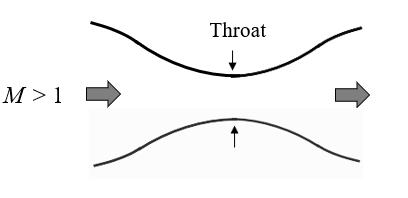
Consider a steady, isentropic, supersonic flow (Mach number M > 1) entering a
Convergent-Divergent (CD) duct as shown in the figure. Which one of the
following options correctly describes the flow at the throat?
Scientific schematic diagram reproduced from official IIT paper
Options:
(A) Can only be supersonic
(B) Can only be sonic
(C) Can either be sonic or supersonic
(D) Can only be subsonic
Official Answer Key:
C
Step-by-Step Solution & Explanation
### **Detailed Step-by-Step Solution (GATE AE 2024 Q.23)**
**1. Supersonic Inflow into a Convergent-Divergent Duct**:
Consider steady isentropic flow with supersonic inlet Mach number $M_1 > 1$ entering a converging-diverging nozzle.
**2. Flow Behavior in Converging Section**:
From the 1D area-velocity relation:
$$\frac{dA}{A} = (M^2 - 1) \frac{dV}{V}$$
For $M > 1$, as area decreases ($dA < 0$), velocity decreases ($dV < 0$) and Mach number decreases toward 1.
**3. Throat Conditions**:
- If the convergence area reduction is exactly sufficient to decelerate the flow to the sonic threshold, the flow becomes **sonic ($M = 1$)** at the throat (choking condition).
- If the area reduction is insufficient to reach sonic conditions, the flow decelerates but remains **supersonic ($M > 1$)** throughout the convergent duct, passing the throat supersonically.
- Therefore, depending on the area ratio $A_{\text{throat}}/A_1$, the flow at the throat can **either be sonic or supersonic**.
**4. Official Master Key**:
- **Official Answer Key**: **C** (Can either be sonic or supersonic)
- **Exam Takeaway**: Supersonic flow decelerates in a convergent duct; it either reaches $M=1$ at the throat or stays supersonic if the area contraction is less than the critical contraction ratio.