Question Statement:
Which of the following statements about a general aviation aircraft, while operating
at point Q in the V-n diagram, is/are true?
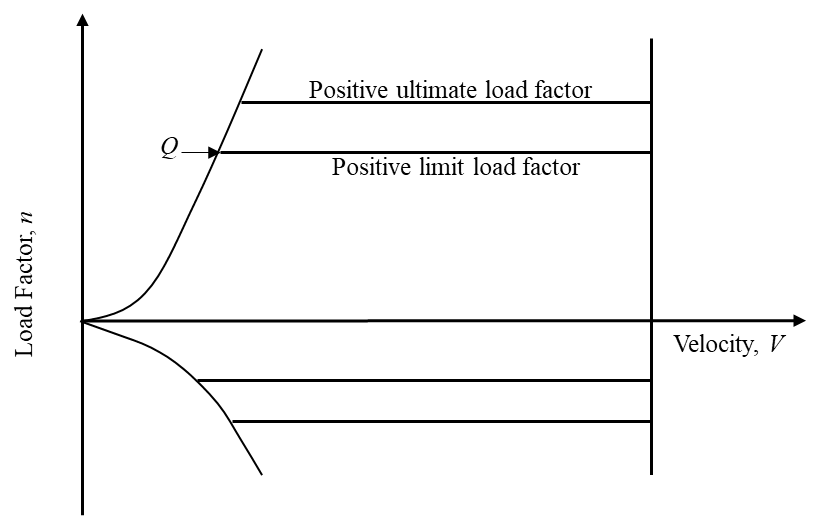
Scientific schematic diagram reproduced from official IIT paper
Options:
-
(A) The aircraft has the highest turn rate
-
(B) The aircraft has the smallest turn radius
-
(C) The aircraft is flying with minimum drag
-
(D) The aircraft is operating at CL,max
Step-by-Step Solution & Explanation
### **Detailed Step-by-Step Solution (GATE AE 2024 Q.28)**
**1. Aerodynamic Turn Performance at Point Q on the V-n Diagram**:
Point Q (often known as the "corner speed" or maneuver point) is located at the intersection of the positive maximum lift line ($C_{L,\max}$) and the structural load factor limit ($n_{\max}$):
- **Operating at $C_{L,\max}$**: By definition of the stall boundary on the $V$-$n$ diagram, Point Q lies directly on the stall line: $n = \frac{\frac{1}{2}\rho V^2 S C_{L,\max}}{W}$. $\implies$ Option (D) is TRUE.
- **Turn Rate $\dot{\psi}$**:
$$\dot{\psi} = \frac{g \sqrt{n^2 - 1}}{V} = \frac{g \sqrt{n_{\max}^2 - 1}}{V_{\text{corner}}}$$
Because $V_{\text{corner}}$ is the lowest airspeed at which $n_{\max}$ can be pulled without stalling, the turn rate achieves its **maximum possible value** at Point Q. $\implies$ Option (A) is TRUE.
- **Turn Radius $R$**:
$$R = \frac{V^2}{g \sqrt{n^2 - 1}} = \frac{V_{\text{corner}}^2}{g \sqrt{n_{\max}^2 - 1}}$$
This airspeed yields the **smallest (minimum) turn radius**. $\implies$ Option (B) is TRUE.
- **Minimum Drag**: The aircraft is at high $C_L = C_{L,\max}$, which produces very high induced drag ($C_{Di} = K C_{L,\max}^2$), far from minimum drag. $\implies$ Option (C) is FALSE.
**2. Conclusion**:
Options **A, B, and D** are correct.
**3. Official Master Key**:
- **Official Answer Key**: **A, B, D**
- **Exam Takeaway**: Corner speed (Point Q) gives instantaneous maximum turn rate and minimum turn radius at $C_{L,\max}$ and $n_{\max}$.