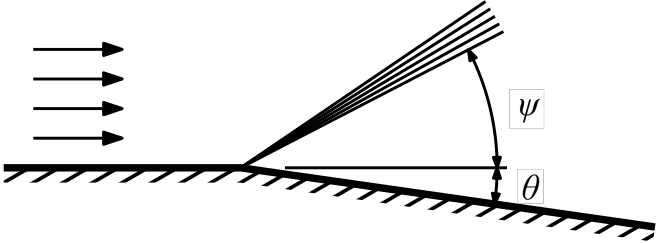
Consider a centered Prandtl-Meyer expansion fan at a $\theta$ = 4° corner in a Mach
1.78 air flow, as shown in the figure below. The angle $\psi$ (see figure) made by the
ending wave of the fan with respect to the incoming stream is
________ degrees (rounded off to 1 decimal place).
An excerpt from the table of Prandtl-Meyer function for air is provided below.
M $\nu$ [deg] M $\nu$ [deg] M $\nu$ [deg]
1.72 18.40 1.82 21.30 1.92 24.15
1.74 18.98 1.84 21.88 1.94 24.71
1.76 19.56 1.86 22.45 1.96 25.27
1.78 20.15 1.88 23.02 1.98 25.83
1.80 20.73 1.90 23.59 2.00 26.38
Scientific schematic diagram reproduced from official IIT paper
Official Answer Key:
27.4
Step-by-Step Solution & Explanation
### **Detailed Step-by-Step Solution (GATE AE 2026 Q.64)**
**1. Intuitive Physical Setup & Given Parameters**:
- Centered Prandtl-Meyer expansion fan at a convex corner of angle $\theta = 4^\circ$.
- Incoming freestream Mach number: $M_1 = 1.78$.
- Excerpt from Prandtl-Meyer function table:
- At $M_1 = 1.78$: $\nu_1 = 20.15^\circ$
- We need to find the angle $\psi$ made by the **ending wave** of the fan with respect to the incoming freestream.
**2. Step-by-Step Gas Dynamic Derivation**:
1. **Downstream Prandtl-Meyer Function $\nu_2$**:
For an expansion fan turning through angle $\theta$:
\nu_2 = \nu_1 + \theta = 20.15^\circ + 4.00^\circ = 24.15^\circ
2. **Find Downstream Mach Number $M_2$**:
From the provided Prandtl-Meyer table:
\nu = 24.15^\circ \implies M_2 = 1.92
3. **Compute Mach Angles**:
- The Mach angle of the downstream flow is:
\mu_2 = \arcsin\left(\frac{1}{M_2}\right) = \arcsin\left(\frac{1}{1.92}\right) \approx \arcsin(0.52083) \approx 31.39^\circ
4. **Determine Angle $\psi$ of Ending Wave Relative to Incoming Stream**:
- The flow has turned downwards by angle $\theta = 4^\circ$.
- The ending Mach wave makes angle $\mu_2$ with the downstream wall/streamlines.
- Tracing angles geometrically with respect to the initial freestream direction:
\psi = \mu_2 - \theta = 31.39^\circ - 4.00^\circ = 27.39^\circ \approx 27.4^\circ
**3. Comprehensive Options & Distractor Analysis**:
- **Evaluation Criteria**: Numerical Answer Type (NAT).
- **Exact Analytical Result**: $\psi \approx 27.39^\circ$.
- **Rounding Requirement**: One decimal place $\implies \mathbf{27.4}$.
**4. Official Master Key & Exam Takeaway**:
- **Official Answer Key**: **27.4** (Acceptable Range: **27.0 to 27.8**)
- **Exam Takeaway**: $\nu_2 = \nu_1 + \theta$, then lookup $M_2$, find Mach angle $\mu_2 = \arcsin(1/M_2)$, and project relative to freestream: $\psi = \mu_2 - \theta$.