Question Statement:
The figure below shows a compressor stage with station numbers 1, 2, and 3 as
indicated. If p0i, T0i, and Ci refer to the average values of total pressure, total
temperature, and absolute flow speed, respectively, at the ith station, select the
CORRECT option considering losses.
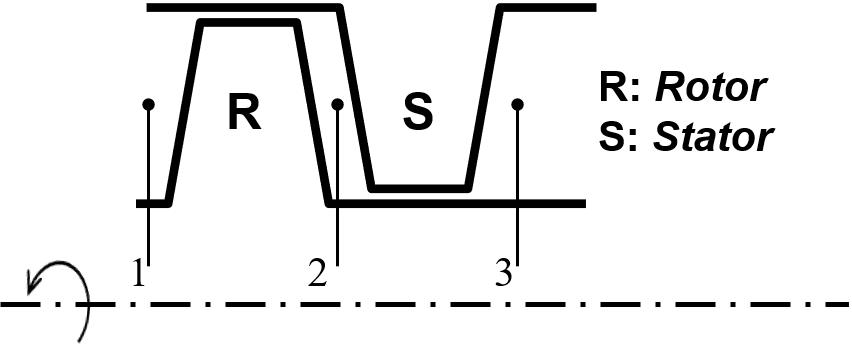
Scientific schematic diagram reproduced from official IIT paper
Options:
-
(A) p01 < p02, p02 > p03 ; T01 < T02, T02 ≈ T03 ; C1 < C2, C2 > C3
-
(B) p01 < p02, p02 = p03 ; T01 < T02, T02 ≈ T03 ; C1 < C2, C2 = C3
-
(C) p01 < p02, p02 > p03 ; T01 < T02, T02 < T03 ; C1 > C2, C2 > C3
-
(D) p01 < p02, p02 < p03 ; T01 < T02, T02 < T03 ; C1 = C2 = C3
Step-by-Step Solution & Explanation
### **Detailed Step-by-Step Solution (GATE AE 2026 Q.42)**
**1. Intuitive Physical Setup & Given Parameters**:
The problem depicts a single stage of an axial compressor:
- Station 1: Rotor inlet
- Station 2: Rotor exit / Stator inlet
- Station 3: Stator exit
We are given total pressure $p_{0i}$, total temperature $T_{0i}$, and absolute flow speed $C_i$ at each station, and asked to identify the correct inequalities considering real losses.
**2. Step-by-Step Turbomachinery Aerodynamic Derivation**:
1. **Total Pressure ($p_{0i}$) Behavior**:
- In the **rotor** ($1 \to 2$), mechanical work is input into the air stream via rotating blades. The total pressure rises significantly:
p_{02} > p_{01}
- In the **stator** ($2 \to 3$), the blades are stationary (no work transfer, $\dot{W} = 0$). Fluid flows through diffusing passages where boundary layer friction and turbulence cause unavoidable stagnation pressure loss:
p_{03} < p_{02} \implies p_{02} > p_{03}
2. **Total Temperature ($T_{0i}$) Behavior**:
- In the **rotor** ($1 \to 2$), work addition increases the stagnation enthalpy and total temperature:
T_{02} > T_{01}
- In the **stator** ($2 \to 3$), since no shaft work is added or extracted and heat transfer through the casing is negligible (adiabatic stationary vane):
h_{03} = h_{02} \implies T_{02} \approx T_{03}
3. **Absolute Velocity ($C_i$) Behavior**:
- The rotor accelerates absolute flow in the tangential direction while diffusing relative velocity, resulting in a net increase in absolute velocity:
C_2 > C_1 \implies C_1 < C_2
- The stator converts dynamic pressure (kinetic energy) into static pressure by decelerating the absolute flow:
C_3 < C_2 \implies C_2 > C_3
4. Combining all three criteria:
p_{01} < p_{02}, \quad p_{02} > p_{03}; \quad T_{01} < T_{02}, \quad T_{02} \approx T_{03}; \quad C_1 < C_2, \quad C_2 > C_3
**3. Comprehensive Options & Distractor Analysis**:
- **(A)**: ✅ **CORRECT**. Accurately satisfies rotor work input ($p_{01}<p_{02}, T_{01}<T_{02}$), stator friction loss ($p_{03}<p_{02}$), stator adiabatic conservation ($T_{02}\approx T_{03}$), and stator diffusion ($C_3<C_2$).
- **(B)**: ❌ **INCORRECT**. Claims $p_{02} = p_{03}$, which ignores stator frictional losses.
- **(C)**: ❌ **INCORRECT**. Claims $T_{02} < T_{03}$, implying work addition in the stationary stator.
- **(D)**: ❌ **INCORRECT**. Claims $p_{02} < p_{03}$, which violates second law of thermodynamics in a stationary duct.
**4. Official Master Key & Exam Takeaway**:
- **Official Answer Key**: **A**
- **Exam Takeaway**: Rotors add shaft work ($p_0 \uparrow, T_0 \uparrow$); stators only diffuse flow without work ($T_0 = \text{const}$, $p_0 \downarrow$ due to entropy generation).